What is the Whitest Tooth Shade for Your Smile? Comparing A1, B1, and C1 Shades

A bright, white smile is one of the most common goals in cosmetic dentistry, but “white” is not actually a single tooth color. Natural teeth come in a range of shades and undertones, which is why dentists use standardized shade guides to evaluate tooth color and help patients establish realistic cosmetic goals. If you are trying to determine the whitest tooth shade for your smile, you may encounter common shade designations such as A1, B1, and C1.
Of these options, B1 is generally considered the whitest natural tooth shade on the traditional VITA Classical shade guide, followed by A1. C1 is also relatively light but has a grayer undertone and is darker in overall value than both B1 and A1. Understanding what these shades mean—and how they differ from the ultra-bright shades possible through cosmetic whitening—can help you determine what type of smile you would ultimately like to achieve.
Natural vs. Artificial Tooth Shade Scales
Before comparing A1, B1, and C1, it is important to understand the difference between a natural tooth shade scale and the brighter shades associated with whitening or cosmetic restorations.
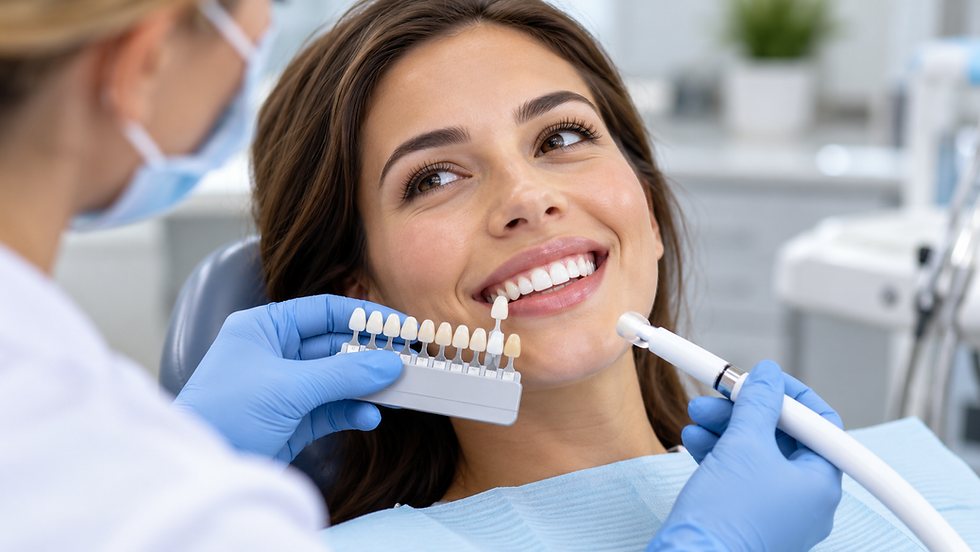
One of the most widely recognized systems in dentistry is the VITA Classical A1-D4 shade guide. It contains 16 natural tooth shades divided into four basic hue groups: A shades are reddish-brownish, B shades are reddish-yellowish, C shades are grayish, and D shades are reddish-grayish. These shades are designed to represent colors commonly found in natural teeth and can help dentists evaluate existing tooth color or coordinate restorations.
However, professional whitening treatments can sometimes produce teeth that appear brighter than the lightest shades represented on traditional natural shade guides. Modern dentistry therefore also uses extended bleaching or “bleach shade” scales to represent exceptionally bright whites that may be achieved through whitening treatments or selected for cosmetic restorations.
This distinction matters when asking, “What is the whitest tooth shade?” B1 is the lightest natural shade on the traditional VITA Classical scale, but it is not necessarily the absolute brightest shade that modern cosmetic dentistry can produce.
Understanding the A, B, C, and D Tooth Shade Families
Natural tooth color is more complex than simply being white, yellow, or dark. The VITA Classical system separates natural shades into four general color families:
A shades: Reddish-brownish undertones
B shades: Reddish-yellowish undertones
C shades: Grayish undertones
D shades: Reddish-grayish undertones
Within each family, numbers indicate variations in the shade. As a result, A1 and B1 may both look very light while still appearing noticeably different because their underlying hues are not the same.
When dentists arrange the VITA Classical shades by brightness rather than simply by letter group, B1 ranks as the lightest, followed by A1 and B2. C1 appears farther down the brightness scale.
A1 vs. B1 vs. C1: Which Is the Whitest Natural Tooth Shade?
While A1, B1, and C1 can all produce relatively bright-looking smiles, they vary in brightness and undertone.
Tooth Shade | Relative Brightness | General Undertone | Overall Appearance | Best Suited For |
B1 | Lightest of the three | Slight reddish-yellow undertone | Bright, clean natural white | Patients seeking the whitest natural tooth shade |
A1 | Slightly darker than B1 | Warmer reddish-brown undertone | Soft, warm, natural-looking white | Patients wanting brightness with warmth |
C1 | Darker than B1 and A1 | Grayish undertone | Cooler and more subdued | Patients whose natural teeth have cooler gray tones |
The important takeaway is that B1 is the whitest natural tooth shade among A1, B1, and C1—and the lightest shade overall when the traditional VITA Classical guide is arranged according to value or brightness.
However, brightness alone does not necessarily determine which shade will look best on an individual smile.
What Does B1 Tooth Shade Look Like?
B1 is widely regarded as an exceptionally bright natural tooth color. Because it represents the highest-value—or lightest—shade within the traditional VITA Classical system, it can create a noticeably white appearance without necessarily crossing into the more dramatic look associated with bleaching shades.

Patients sometimes wonder, “Is B1 tooth shade too white?” For most people, B1 is not inherently an unnatural shade because it remains within a standardized natural shade system.
That does not mean B1 will look identical on every person. Your skin tone, lip color, surrounding teeth, facial characteristics, lighting, and even the translucency of your enamel can influence how bright B1 appears.
What Does A1 Tooth Shade Look Like?
A1 is also one of the brightest natural shades, but it is slightly darker than B1 when evaluated according to value.
Because A shades contain warmer undertones, A1 often produces a softer or creamier appearance compared with B1. For someone who wants noticeably white teeth but prefers a warmer and less striking result, A1 may provide an appealing balance.

A1 can therefore be an excellent natural-looking shade even though it is technically not the whitest natural tooth shade.
What Does C1 Tooth Shade Look Like?
C1 is another relatively light natural tooth color, but its appearance differs significantly from A1 and B1.
The C family contains grayish undertones. As a result, C1 can have a cooler and slightly more muted appearance. When natural VITA shades are arranged from lightest to darkest, C1 comes after several lighter shades, including B1, A1, B2, D2, and A2.

Someone with naturally cooler tooth coloring may therefore find that C1 blends more harmoniously with their existing smile, even though it is not as bright as B1 or A1.
What Is the Best Tooth Shade for Your Smile?
The whitest tooth shade is not automatically the best shade for every patient. A smile generally looks most attractive when its brightness works naturally with the rest of the face.
The ideal result may depend on your:
Natural Starting Shade
Someone beginning with relatively light teeth may require only subtle whitening, while deeper discoloration may require a more comprehensive approach.
Skin Tone
Contrast between your complexion and your teeth can influence how white a particular shade appears.
Age
Extremely bright teeth may produce a different aesthetic effect depending on a person's age and overall facial characteristics.
Existing Dental Restorations
Whitening products brighten natural enamel but do not change the color of crowns, veneers, or fillings. Your dentist may therefore need to consider existing restorations when developing a cosmetic plan.
Personal Preference
Some patients want the brightest smile realistically achievable, while others prefer a subtle improvement that retains more of their natural warmth.
Ultimately, the best target should be individualized rather than based solely on a shade number.
Professional Teeth Whitening at Science of Smiles in Pasadena
At Science of Smiles in Pasadena, we combine compassionate, individualized dental care with modern technology and science-driven treatment. Led by Dr. Stephanie P. Lee, DDS, our practice takes a biomimetic approach focused on preserving and strengthening natural teeth while helping patients achieve healthy, attractive smiles. Our office incorporates advanced technologies including 3D scanners, CBCT imaging, dental lasers, and milling technology as part of our comprehensive approach to preventive, restorative, implant, Invisalign, and cosmetic dentistry.
For patients who want a brighter smile, we provide professional teeth whitening using the Opalescence Teeth Whitening System. Our in-office treatment uses chemically activated Opalescence whitening gel, allowing it to address discoloration without requiring a UV light or heat source. We also offer professional take-home options for patients who prefer gradual whitening or want a convenient way to maintain their results. The Opalescence family includes professional take-home whitening products designed to provide customizable whitening under dental guidance.
Whether your goal is to move closer to B1, brighten your existing natural shade, or simply reverse years of staining, we can evaluate your starting shade and recommend an approach based on your teeth, sensitivity, lifestyle, and cosmetic preferences.

Find the Whitest Tooth Shade That Complements Your Smile
So, what is the whitest tooth shade? On the traditional VITA Classical scale, B1 is considered the whitest natural tooth shade, with A1 following closely behind. C1 is also relatively light but has a cooler gray undertone and lower overall brightness. Modern professional whitening may potentially produce an even brighter appearance depending on your starting shade and how your enamel responds.
More importantly, the best smile is not necessarily the one with the brightest shade number. At Science of Smiles in Pasadena, we can help you determine a level of whitening that complements your natural appearance while prioritizing the health and integrity of your teeth.
Ready to discover how much brighter your smile could be? Call Science of Smiles at (626) 795-0221 or book an appointment directly online to discuss our professional Opalescence teeth whitening options and find a whitening treatment that fits your goals.
FAQs
What is the whitest natural tooth shade?
B1 is generally considered the whitest natural tooth shade on the traditional VITA Classical shade guide. It is slightly brighter than A1 and noticeably lighter than C1.
What is the difference between A1, B1, and C1 tooth shades?
B1 is the brightest of the three, A1 is slightly warmer and darker, and C1 has a cooler grayish undertone. Each can look natural depending on the individual smile.
Can teeth be whiter than B1?
Yes, professional whitening and cosmetic restorations can sometimes create shades that appear brighter than B1. These are often referred to as bleach shades rather than traditional natural tooth shades.
How many shades can professional teeth whitening lighten teeth?
Professional whitening can often brighten teeth by several shades, although the exact improvement varies from patient to patient. Your dentist can evaluate your starting shade and provide more realistic expectations.


Comments